Under-Bed Storage: What Fits and What You Can Actually Reach
· SmallSpace AI Editorial
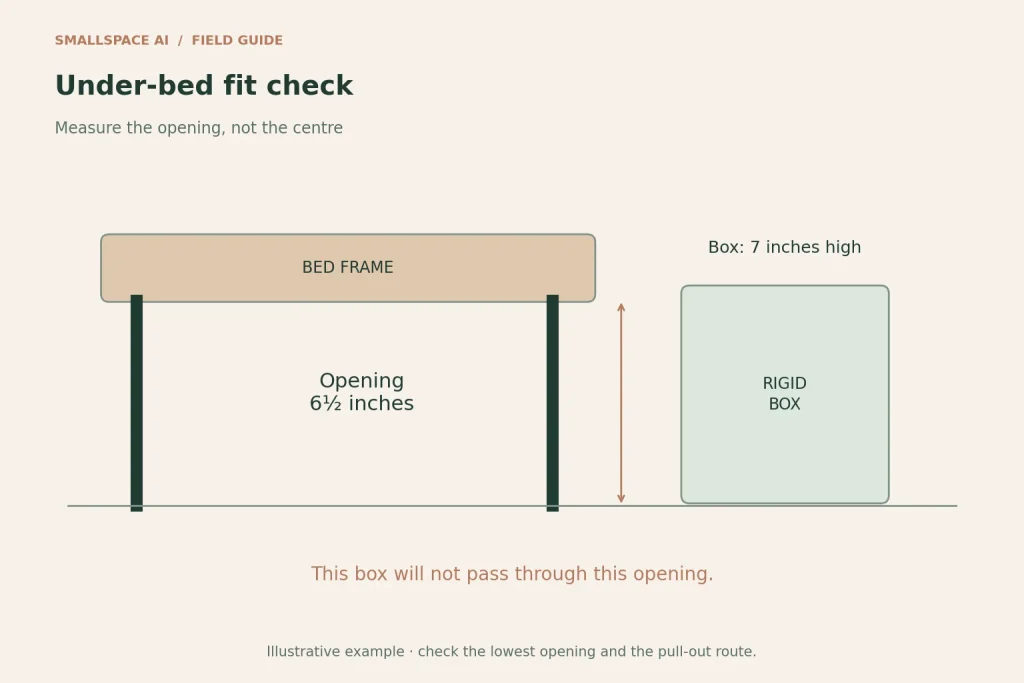
Illustration: an explanatory diagram, not a photograph or a construction drawing.
The space under a bed is useful only when a container can pass through the opening and come back out. A box that fits beneath the centre may be blocked by a low side rail, a support leg or the bedside table. Measure the path into the space before counting its storage capacity.
Take four measurements
Measure the lowest opening under the side or foot of the bed, the usable depth before a support, the width between legs, and the floor space available to pull a box out. Include the height of wheels, handles and the closed lid. Do not rely on the container’s internal capacity to tell you its external size.
For an illustrative example, a 6½-inch opening will not admit a rigid 7-inch-high box even if the central clearance is 9 inches. A flexible bag might compress, but a lid and wheels will not. Leave handling room rather than choosing a container that must scrape through a tight opening.
Map supports before dividing the space
Look for centre legs, crossbars, drawers and lifting mechanisms. Draw separate usable areas rather than treating the entire mattress footprint as one empty rectangle. Follow the bed manufacturer’s instructions and do not remove supports to make storage fit.
A pair of smaller containers can be easier to retrieve than one wide box. The trade-off is more handles and lids to manage. Choose the arrangement based on the items and the side of the bed you can actually access.
Match the container to the contents
Shallow rigid boxes protect their shape and can be easy to label, but their lids need opening space. Soft zipped bags adapt around textiles but may be harder to slide on carpet. Drawers built into the bed can provide convenient access only when there is enough room to extend them.
Keep belongings dry before packing. Avoid filling the space so densely that cleaning and the bed’s required ventilation become difficult. Inspect periodically rather than treating the area as permanent sealed storage. Follow any special storage requirements for the items themselves.
Store by retrieval frequency
Place current bedding or regularly used items nearest the accessible edge. Put seasonal textiles farther back only when you can still reach them safely. Label the outward-facing side, because a label on the top disappears as soon as the box is pushed under the bed.
Do not make a daily routine depend on lifting a heavy mattress or moving the entire bed. If something is needed every morning, a reachable shelf or drawer may be better. Under-bed capacity is not a substitute for convenient everyday storage.
Try one container first
Before buying a matching set, fill one suitably sized container with the intended items. Close it, move it into position and pull it out again with the bedside furniture in its normal place. Test with bedding hanging as it usually does, since a bed skirt can conceal handles and catch on wheels.
The test also reveals whether a heavy box is manageable on your floor. A container that rolls easily on a hard shop floor may behave differently on carpet or across a rug edge.
Avoid solving clearance with unverified bed risers
Raising a bed changes its height and support conditions. Do not assume any riser works with any leg, frame or load. Use only a compatible system approved for the bed and follow its instructions. If that cannot be established, choose shallower storage instead.
For a room without a wardrobe, combine this space with the reachable storage in our no-closet bedroom guide. If retrieval space is the problem, compare the furniture positions in our 8×10 bedroom layouts before buying more containers.
Leave a Reply