Small Bathroom Storage Without Drilling: Work Around Water and Doors
· SmallSpace AI Editorial
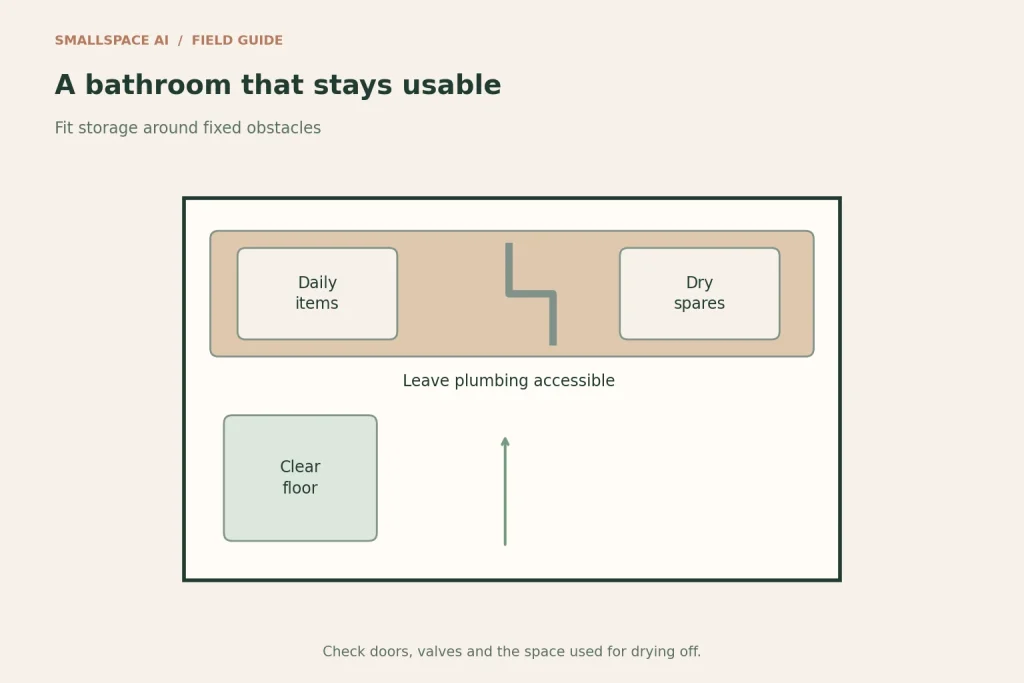
Illustration: an explanatory diagram, not a photograph or a construction drawing.
In a small bathroom, unused-looking space often belongs to a moving door, a person drying off, or plumbing that needs access. The first storage upgrade is separating what you use every day from backup supplies. Then choose an organiser for the remaining items, not for an empty corner in a photo.
Start with three groups
Keep daily toiletries near their point of use. Put spare paper, unopened products and extra towels in a dry location that does not crowd the daily routine. Keep cleaning products in their original labelled containers and store them according to their instructions, with appropriate protection from children.
Count duplicates before buying a new tower. Moving a month’s spare supplies to another cupboard can free more useful bathroom space than adding a unit beside the toilet. A bathroom cabinet is not necessarily a suitable location for medicine; follow the medicine’s storage instructions.
Measure around pipes and access points
Inside a vanity, measure each usable section separately. Record where the drain, supply lines and valves sit. A single wide basket may collide with the pipe, whereas two smaller removable bins can leave the centre accessible.
Do not box in a valve or conceal a leak behind tightly packed items. Lift the bins periodically to check the surface beneath them. If a storage product needs cutting or permanent attachment to fit, it may be the wrong choice for the rental.
Use vertical space without assuming stability
A short freestanding shelf can keep towels accessible when its feet sit fully on a level surface. Follow its load limits and anchoring instructions. An over-toilet unit may require securing to the wall even if it is sold as freestanding; do not omit required anchors to make it renter-friendly.
Check the toilet lid, cistern access and flush controls with the unit in place. Avoid making routine cleaning so awkward that you must dismantle the entire arrangement. Heavier supplies belong low in a stable unit rather than balanced on its highest shelf.
Match shower storage to the fixing system
A hanging shower caddy must be compatible with the fixture supporting it. A tension organiser needs the exact floor and ceiling conditions its manufacturer specifies. Neither is a universal fit. Test that bottles remain secure and that the holder does not obstruct taps or the shower door.
An adhesive bathroom product also needs the correct surface and installation conditions. Do not apply generic indoor hooks in a wet area on the assumption that all removable adhesives are interchangeable. See the manufacturer’s product-specific instructions for the relevant type, and follow the instructions supplied with your own product.
Keep the floor route usable
Place a potential basket or trolley footprint before loading it. Open the room door, cupboard and shower enclosure. Stand where you normally dry off and reach for a towel. If the organiser occupies that space, move spare towels outside the bathroom rather than narrowing the route.
Avoid routing appliance cords across the floor or improvising electrical storage near water. This guide changes storage positions, not electrical installations.
A practical setup for a pedestal sink
Without a vanity, begin with one small removable toiletries basket on an existing dry surface. Put backup products in a labelled box elsewhere. Add a low freestanding unit only if it fits beyond the door swing and meets its stability instructions. Keep pipework accessible rather than wrapping it in an improvised cabinet.
The result may use fewer visible organisers than a styled bathroom, but every item has an accessible home. The same obstacle-first method appears in our small rental kitchen guide and storage upgrade checklist.
Leave a Reply