Renter Storage Upgrades: A Room-by-Room Decision Guide
· SmallSpace AI Editorial
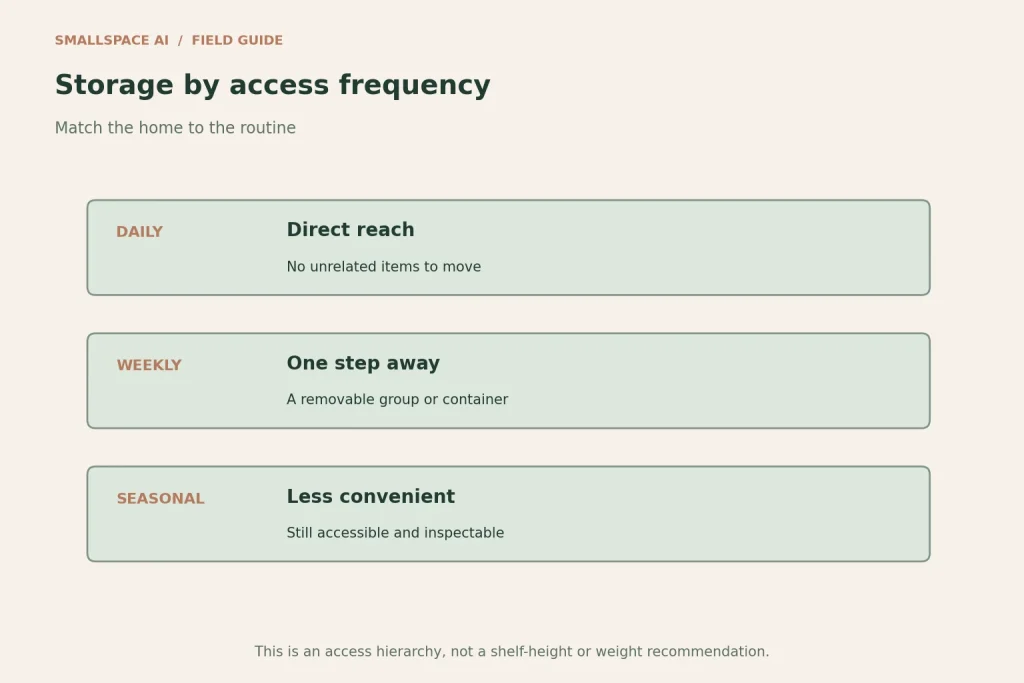
Illustration: an explanatory diagram, not a photograph or a construction drawing.
The most useful storage upgrade makes an item easier to put away as well as easier to find. More capacity alone is not enough. If a container requires moving three other containers, belongings may continue to collect on the nearest table.
Start with one recurring pile and identify what it contains. Shoes, paperwork, spare bedding and cleaning supplies need different homes. Choosing by the actual contents reduces the chance of buying a set of attractive boxes that does not solve the problem.
Sort by how often you need access
Place daily items where they can be retrieved directly. Weekly items can use a less convenient shelf. Seasonal belongings can sit farther back, provided you can still reach and inspect them without unsafe lifting or dismantling furniture.
Keep items used together in the same zone when practical. This might mean a breakfast bin in the kitchen or a work basket beside a shared desk. Avoid grouping things only because their containers match.
Measure the complete access path
Measure the opening, internal space, obstructions and room required to pull the organiser out. Include handles and lids. A basket that fits a shelf can still be impossible to lift past a hinge or rail.
The cover diagram shows a simple access ladder: everyday items in direct reach, occasional items one step away, seasonal items farther back. It is a retrieval principle, not a recommendation to place heavy objects overhead.
Try the lowest-commitment option first
A cleaned, suitable container you already own can test the size and location. Use it for a few normal days before purchasing a matching set. A temporary trial reveals whether the location supports the routine or simply hides the pile.
Check suitability for the contents. Food needs appropriate food-storage containers; wet items need an arrangement that does not trap unwanted moisture. Do not reuse containers with an unknown history for food or personal-care products.
Match the upgrade to the room
In the kitchen, a shelf insert or removable task bin can improve access inside existing cabinets. In the bedroom, shallow containers may suit spare textiles if the bed opening and pull-out route allow them. At the entrance, limiting current footwear can be more useful than buying a larger rack.
Start with the specific guides for small kitchens, under-bed storage and tiny entrances. Their measurements differ because the obstacles differ.
Check stability and fixing requirements
A freestanding label does not mean a unit never needs anchoring. Follow the manufacturer’s assembly, load and anti-tip instructions. Do not leave out a required fixing to preserve a no-drill claim. Choose a different type of storage if the required installation is not allowed.
Over-door holders must allow the door to close normally and must not interfere with hinges or shelves. Adhesive products need compatible surfaces and correct installation. The smallest commitment may be a low organiser inside an existing cupboard rather than a new tall tower.
Give the system a limit
Assign one container or shelf to a category, then notice when it fills. Before adding capacity, remove items that belong elsewhere or are no longer needed. A defined limit makes it easier to maintain the room and prevents storage furniture from consuming the useful floor area.
After a week, ask whether putting items away is faster, whether doors still open and whether the floor is easier to clean. Keep upgrades that improve those tasks. Return unsuitable products when their condition and the retailer’s policy allow it, rather than forcing the room to fit them.
Leave a Reply