How to Make a Small Bedroom Feel Bigger Without Renovating
· SmallSpace AI Editorial
Quick answer
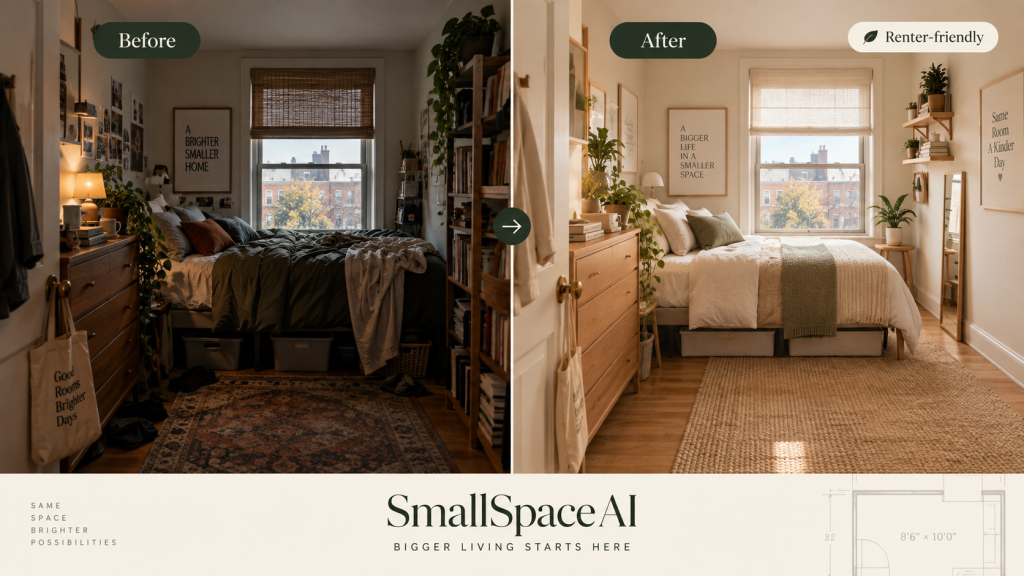
A small bedroom feels bigger when you reduce visual weight, keep more floor visible, protect a clear walking path, and let light travel across the room. For renters, the highest-impact changes are usually furniture scale, bed placement, curtains, mirrors, lighting, and hidden storage rather than renovation.
Who this is for
This guide is for renters with compact bedrooms, especially rooms around 8×10 to 10×12 feet, who want the space to feel calmer and more open without changing walls, flooring, or permanent fixtures.
Measure these four things first
- Room width and length: measure wall to wall, not just the open floor.
- Bed footprint: include the frame, not only the mattress.
- Walking path: note the narrowest route from the door to the bed, window, and closet or dresser.
- Window and door swings: mark the floor area that has to stay clear.
Do this before buying anything. In a small room, a two-inch difference in furniture depth can matter more than another decorative trick.
Which changes make the biggest difference?
| Change | Cost | Drilling | Impact | Best for |
|---|---|---|---|---|
| Use a slimmer bed frame | $$ | No | High | Bulky beds |
| Raise curtains visually | $ | Optional | Medium–High | Low-feeling ceilings |
| Place one large mirror strategically | $–$$ | No* | Medium | Dark rooms |
| Move storage under the bed | $–$$ | No | High | Visible clutter |
| Replace deep nightstands | $–$$ | No | High | Narrow side clearances |
| Add two or three light sources | $–$$ | No | Medium | Flat, shadowy rooms |
*Use a freestanding or renter-safe mounting method that is appropriate for the mirror’s weight.
1. Start with the bed, because it controls the room
The bed is usually the largest object in a small bedroom. Place it first, then judge everything else around the walking path it creates. If a bulky frame, oversized headboard, or wide side rails consume several extra inches, the room can feel crowded even when the mattress itself fits.
Choose a frame with a visually light profile, visible legs, or useful under-bed clearance. The goal is not minimalism for its own sake. It is to stop the bed from reading as a solid block that fills the room.
2. Protect one clear route through the room
A room feels tighter when you have to turn sideways around furniture. Prioritize one obvious path from the door to the bed and the room’s main destination, such as a window, dresser, or wardrobe. A practical target is roughly 24 to 30 inches where possible, but your real room, door swing, and accessibility needs come first.
If the route is pinched, remove depth before removing function. A 14-inch-deep dresser may work better than a 20-inch-deep piece even if both technically fit.
3. Keep more floor visible
Visible floor creates visual continuity. Use furniture with legs, avoid storage spilling into the walkway, and group smaller items instead of scattering baskets around the room. Under-bed boxes are useful when they reduce visible clutter rather than simply adding more storage to fill.
4. Use curtains to stretch the window visually
When your lease allows it, hang curtains higher and wider than the window frame so more glass remains exposed when the curtains are open. If drilling is not allowed, use a renter-safe tension or removable system that is rated for the fabric weight. Light, simple curtains usually create less visual bulk than heavy, overfull panels in a very small room.
5. Make a mirror reflect something useful
A mirror is most effective when it reflects daylight, a window, or the longest sightline in the room. A mirror facing a cluttered rack simply doubles the clutter. One well-placed larger mirror usually creates a cleaner effect than several small mirrors scattered across different walls.
6. Reduce visual breaks
Too many small furniture pieces, colors, storage containers, and wall decorations divide the room into fragments. Repeat a limited palette across bedding, rug, curtains, and storage. This does not mean everything has to be beige. It means the eye can travel without being stopped every few inches.
7. Layer the lighting
One ceiling bulb can create dark corners that make the room feel smaller. Add a bedside light and a second light near a desk, dresser, or opposite corner. Plug-in lamps and renter-friendly sconces can improve depth without electrical work.
8. Hide storage where it does not interrupt the room
Use under-bed storage for low-frequency items, one dresser or wardrobe for the bulk of clothing, and a small reset zone for things you use every day. Storage works best when it reduces the number of visible objects rather than adding more containers to every surface.
9. Remove one piece before adding another
Before buying a new organizer, ask what it replaces. In an 80- to 120-square-foot bedroom, every new piece should either solve two jobs or improve circulation. If it does neither, it is probably making the room work harder.
Common mistakes
- Buying storage before measuring the room.
- Using a rug that creates a tiny island in the center of the floor.
- Placing a mirror where it reflects clutter.
- Choosing furniture by width only and ignoring depth.
- Adding multiple small organizers instead of one clear storage system.
- Blocking natural light with tall furniture near the window.
Small bedroom checklist
- Measure the room and bed frame.
- Mark door and window clearances.
- Choose the bed position first.
- Keep one clear walking route.
- Move low-frequency storage under the bed.
- Use one strong mirror position.
- Add layered lighting.
- Remove visual clutter from open surfaces.
What to change first based on the problem
| If the room feels… | Change first | Why |
|---|---|---|
| Blocked | Fix the walking path | Circulation changes how large the room feels before decor does. |
| Dark | Expose more window area and add layered light | Brighter corners increase visual depth. |
| Heavy | Reduce bulky furniture and bedding | Less visual mass keeps more floor and wall visible. |
| Cluttered | Consolidate storage | One clear system reads calmer than many small organizers. |
Renter-safe checks before mounting anything
Do not assume every removable hook, tension rod, or adhesive strip is safe for every wall. Check the product’s surface guidance and rated load, test delicate paint in an inconspicuous area, and avoid hanging heavy mirrors from a system that is not designed for that weight. When in doubt, choose a freestanding mirror, lamp, shelf, or wardrobe instead. The room should feel bigger without putting your deposit or safety at risk.
Next guides
If storage is the main problem, read Small Bedroom Storage Ideas for Renters With No Closet Space. Our measured 8×10 bedroom floor-plan guide is coming next.
Leave a Reply